
Background
Fighting Fantasy books usually have a few pages of prose at the beginning that sets the scene for your quest, nine times out of ten this will boil down to something along the lines of "The Boss Skeleton is gathering a skeleton army that threatens the land, you better kill that big old skeleton!" Or perhaps you have to get a magic rock from on top of a mountain and show it to the boss skeleton and then he turns to dust and his army of SKELETONS return to their usual passtime of collecting rusty sabres and waiting around in unexpected places. But that is the general vein of these things.
As the first book in the series, "Warlock" doesn't even have this much story set up. It's kind of a prototype I guess. Basically, the Warlock has some treasure and you've decided to take it off him. That's it. The Warlock of Firetop Mountain doesn't even have a name. He probably can't get a passport. I guess when he's at Firetop Mountain he can just be all "i'm the warlock. do you see any other warlocks here? didn't think so", but if he goes anywhere else that shit won't play.
According to the little bit of back-story that is provided, you spend a few days in a nearby village talking to the "local peasants" and collecting rumours. Basically you are told that you will probably die, and that you should talk to the village graph paper merchant because you're gonna want a map. You also hear what the gossip mags have to say about the Warlock - some said his power came from an enchanted deck of cards, others from the silky black gloves that he wore. Sounds pretty fruity to be honest. I reckon I can take this guy.

COULD THIS BE THE WARLOCK OF FIRETOP MOUNTAIN
Rolling Up My Dude
Starting stats:
SKILL - 11
STAMINA - 16
LUCK - 8
Quite happy with that roll for SKILL. Part of the theory of good design for FF is that, if you make the correct choices you should be able to get through with a low-skill character, i.e. no difficult fights. However since most of my choices will be between "go left", "go right" and possibly "go straight ahead", my judgment probably won't count for much.
I had a choice of three potions, and took the Potion of Fortune (restores LUCK - didn't end up using it).
I should mention that everything from here on in contains spoilers, so any readers who want to have an unadulterated first experience of a gamebook from 1982 should probably not continue.
The Adventure
Firetop Mountain is kind of a weird environment. The area near the entrance is populated with ORCS and GOBLINS who are all either asleep or getting drunk. This is fairly typical of the media's negative stereotyping of such creatures. The orcs/goblins live in unadorned rooms that usually contain a straw pallet, a small box with mysterious contents, and nothing else (well, maybe a table in some cases). Passing through, you do not get the sense that they have many amenities, they have been poorly provided for and have little to do. Many are fairly clearly depressed (at least up until the moment that you murder them). In one notable encounter, I barged in on a couple of GOBLINS who had just tortured a DWARF to death. I was given the option of rushing in, stabbing the dead DWARF and faking an evil laugh.
("hey, what's up, guys? you doing evil stuff? that a dwarf you got there? you torturing a dwarf, huh? hey, that's cool. HA HA HA HA HA i'm evil too you see. did i mention that? let's party")
I like to think this option could've lead to handshakes, shy introductions and then perhaps it'd be back to their nondescript room for a few rounds of disgusting swill.

These fellows plainly feel that life has let them down.
But I just killed them instead because I'd already realized that with SKILL 11 it was mathematically impossible for GOBLINS (SKILL 5) to hit me, so I didn't need to bother with the dice rolls.
Along the way to the underground river in the middle of the dungeon there are a few amenities, such as an armour storage room, and a strangely out-of-place shop where a gregarious man sells Blue Candles and apparently nothing else. These are weird glimpses of some kind of functioning community in Firetop Mountain, but it's hard to make sense of it. In one bizarre encounter, I swapped swords with some kind of invisible water spirit - "Thanks!" the entity responded flippantly after I threw my sword into the river.
On the other side of the river (the PIRANHA-infested river, naturally) you soon find yourself stuck in the Maze of Zagor, which is extremely boring. I think it took me more than an hour of cardinal-direction-choosing action to get through. I was determined not to make a map, so in the end what I did was keep a list of passage numbers that I'd already read and avoided choices that led back to numbers I recognized. Eventually this approach got me out. That maze was pretty annoying. There are secret doors in the maze but you are generally punished for looking for them - either by having to fight wandering monsters or occasionally, you'll be knocked out by gas and wake up in another part of the maze... not clear who's hauling your comatose body around in these circumstances. I think Messrs. Jackson and Livingstone must've learned from the fun deficit in this episode as I don't recollect any of the other books having anything quite as irritating in them.
Not too long after your eventual escape from the maze, you stumble across the Warlock himself, who like most inhabitants of Firetop Mountain is sitting around in a non-descript room (why is there no decor in this place?). More on him in a moment.
Monsters & Combat
Subsequent books in the FF series saw some quite interesting monster design, such as the Bloodbeast from Deathtrap Dungeon. However Firetop Mountain sticks to pretty standard fantasy tropes - GHOULS, GIANT BATS, TROLLS, etc. I look forward to meeting some more intriguing old friends such as the MESSENGER OF DEATH in future episodes (also the books where you fight DINOSAURS).
In terms of combat difficulty, it was surprisingly easy. With SKILL 11 it was doddle, most monsters I faced had SKILL of 5 or 6 with the occasional 7. To put it in perspective, a SKILL 7 monster could only damage me if they rolled a 6 and I rolled a 1. SKILL 5 and 6 could never damage me at all. My toughest opponent was this wiseguy:

Disturbingly, this MINOTAUR seems to have murdered a BABY MINOTAUR and re-purposed its skull to embellish his undies.
And note, once again, the featureless room that serves as this poor soul's home.
His stats? SKILL and STAMINA of 9. So, not too much of a challenge either.
But surely the Warlock himself is a bit of a hard nut? Well, let me tell you about that...
Failure and Death
The Warlock was hanging out in just another room facing directly onto one of Firetop Mountain's many corridors. When I blundered in he was disguised as an old geezer playing Solitaire with a possibly magical deck of cards. (The text neglected to mentioned whether he was wearing his black silky gloves so I figured the gloves must have been a red herring). I don't know whether this was for my benefit, but since none of my previous encounters seemed to indicate that anyone was alert to what I was up to, I suspect it was just normal R&R for the guy.
The Warlock briefly hypnotized me and used the opportunity to shed the "old man" illusion, get geared up in his arse-kicking pants and go stand on the other side of the room, leaving his deck of cards on the table next to me. With a successful Test Your Luck I remembered how those mangy old peasants had pestered me with their theories about the Warlock's magic deck of cards and promptly burned them, which weakened the Warlock down to a paltry SKILL 7. From there it was an trifling matter to put him to the sword.
Had there been any inherent reason for offing the Warlock, I could at this stage have confidently turned to 400, but, you'll recollect that I was only there for the treasure. Bashing into an adjoining room, I was presented with a chest with three locks on it. Given that I had only found one key on my travels, I attempted to smash the chest open and was zapped by a magic trap and, failing a Test Your Luck, was killed - "your charred remains have formed a small black outline on the floor" - no doubt leaving a cryptic crime scene for some intoxicated GOBLINS to ponder when they wander up to the Warlock's office to ask why their pay-cheques haven't been coming in.
This was a fittingly absurd end to an absurd adventure, the seemingly innocent master of the dungeon and I, his bumbling assailant, both terminated for the sake of a box of non-specific "treasure" that may well have been a stack of old Hustler magazines that the Warlock didn't want the cleaning GNOMES to find.
The alternative for those with insufficient keys is literally to sit on the chest and bawl your eyes out, so, at least I went out with a kind of idiotic dignity. I have no idea where the other keys were (the one I had was sitting in the bottom of a pot of fake gold in the MINOTAUR's room), and I daresay you'd have to play through multiple times to find them. The first decision you have to make in Warlock is whether to go east or west after entering the tunnels under the mountain. I went west, and it may be that I immediately lost the game by doing so.
SKELETON Report
To my surprise I did not encounter any SKELETONS during my adventure, however, after playing I quickly skimmed through the book to find them. My conclusion?

What were they doing? Well, five of them were building a boat.

Please note that I am only counting SKELETONS who have been somehow animated by dread arts, not garden variety inanimate skeletons such as the ones being cared for by these little rascals:
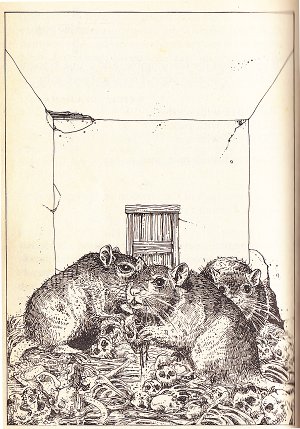
"Why, hello!"
Skeletons that are clothed in flesh and moving around inside bodies will not be counted either, but we must never forget they are there.
Final Thoughts
Ultimately, "Warlock" comes off as a series of interesting but disconnected encounters playing out in a largely bland, unembellished environment. Firetop Mountain seems like dungeon equivalent of a newly completed office building, all fitted out but with scant contents and zero character. I never really had a coherent sense of what was happening or why.
I found myself wondering how all of these creatures get by and what kind of relationships they have with each other. Does the VAMPIRE catch a ride with the FERRYMAN across the river when he wants to go to the candle shop? And does the FERRYMAN pull that same bullshit charging 3 gold pieces when the sign only says 2, or is that shit just for TOURISTS? What does the DRAGON eat? Does the MINOTAUR stay in the same room all day? Were all of these guys reporting to the Warlock? Did they have meetings? Where are the toilets? And so on.
I shouldn't judge too harshly though - this is book #1, and 1982 was back in the early days of role-playing when corridors connecting a series of rooms containing monsters guarding boxes holding traps and/or treasure was what it was all about. Excepting the maze, it's pretty fun to play, and with a little charitable imagination you can imagine explanations for out-of-place stuff like the candle shop and the poker-playing midgets in the maze (oh, did I not mention them?) And the apparent incoherence of goings-on within the dungeon is fairly consistent with the notion that you're just some guy breaking and entering, which is exactly the case.
And what's more of course, "Warlock" laid the foundation for a hell of a lot more to come...


